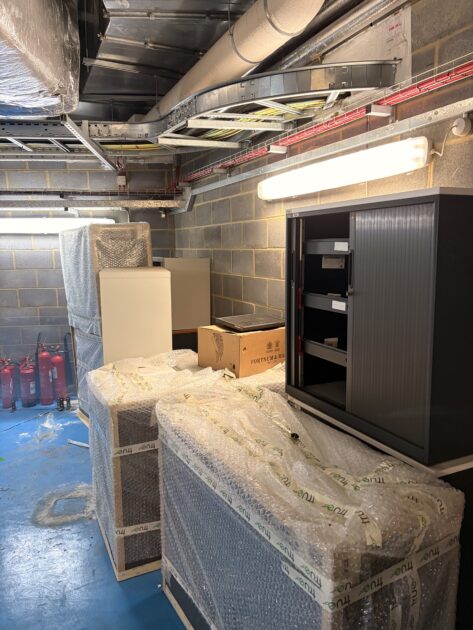
During the week ending Friday 21 August 2026, London City Waste Clearance carried out an office furniture clearance in EC2R, in the City of London. The job involved removing old metal filing cabinets, metal cupboards and office pedestals from a lower basement.
The collection filled one vehicle load, with further items remaining. Our vehicle returned the following morning to collect the rest of the metal pedestals and cabinets.
Metal office cupboards awaiting collection from the lower basement in EC2R.
A 5am start to work around building users
The job started at 5am to avoid the busier period when people on site would be using the lift and hallways.
Our vehicle parked in the loading bay, which was connected to the lower basement by a lift. This provided the route for moving the furniture from the storage area to the vehicle.
Moving cabinets from the basement to the loading bay
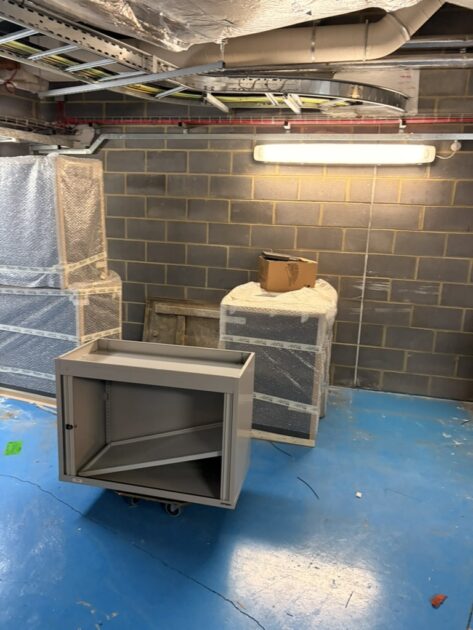
The team used a furniture skate—a wheeled platform—to move the cabinets along the hallways to the lift and through to the loading bay.
A furniture skate was used to move the cupboards towards the loading bay lift.
Access was an important part of this collection. The early start, loading bay and lift route allowed the team to organise the removal around the building’s shared spaces. After the first full load, the remaining cabinets and pedestals were collected on the return visit the next morning.
Loading metal office furniture at the EC2R collection site.
Planning an office furniture clearance in London?
If you need filing cabinets, cupboards, desks or other office furniture removed, tell us your postcode, the approximate quantity and any access restrictions.
For basement collections, please include details of the lift, hallways, parking and permitted loading times so we can plan suitable collection arrangements.
EC1 Commercial Waste Collection for Offices, Shops and Studios
Commercial waste can build up differently across EC1. An office may need packaging, old equipment and storage-room waste removed. A shop may have cardboard, display materials or unwanted stock. A creative studio may need to separate ordinary business waste from electrical equipment, paints, liquids or other items that require confirmation before collection.
A useful EC1 commercial waste collection starts with a clear description of the waste, the premises and the access. That information helps determine whether the job is a straightforward one-off collection, part of a wider clearance, or a repeat requirement that needs more planning.
Need waste collected from an EC1 business? Send LCWC photos, rough quantities, the postcode, waste-stream details, floor and lift information, loading or parking constraints and your preferred collection time. LCWC can review one-off, urgent or repeat enquiries where the waste type, access and schedule are suitable.
What commercial waste collection involves
Waste from a commercial activity is business waste. Businesses are responsible for keeping waste to a minimum, sorting and storing it safely, using an appropriately registered carrier and completing the required transfer documentation.[1]
For a practical collection enquiry, identify:
what the waste is;
approximately how much there is;
whether it is loose, bagged, boxed, stacked or bulky;
whether different waste streams are already separated;
where it is stored;
how it can leave the building;
whether the job is one-off, repeat or connected to a move, refit or handover;
what collection paperwork the business or building requires.
Commercial collection is not the same as placing household rubbish outside. The business remains responsible for managing its waste safely and describing it accurately.
Different EC1 premises create different collection needs
Offices
Office waste may include paper and card, packaging, broken stationery, general residual waste, old furniture and electrical items. Desks, chairs, filing cabinets and larger clear-outs may be better planned as an office clearance rather than treated as routine bagged waste.
Before requesting a quote, separate:
ordinary office and kitchen waste;
paper and cardboard;
furniture and bulky items;
monitors, printers, cables and other WEEE;
confidential papers or data-bearing equipment;
items owned by a landlord, employee, supplier or leasing company.
Shop waste can change with deliveries, seasonal stock, merchandising and refits. It may include cardboard, plastic packaging, display materials, shelving, fixtures, damaged goods and ordinary staff or customer waste.
Retail teams should confirm:
whether packaging can be flattened and kept dry;
whether unwanted stock has a separate return, donation or disposal route;
whether fixtures need dismantling;
whether food waste is produced;
where waste can be stored without blocking customers, staff or fire routes;
the permitted collection point and time window.
Do not assume liquids, chemicals, batteries, aerosols, fluorescent lamps or unusual products can join a standard collection. Raise them before booking.
Studios and creative workspaces
Studios may produce a mix of ordinary office waste, packaging, samples, set materials, boards, offcuts, electronic equipment, paints, adhesives or other specialist items. The word “studio” does not describe the waste stream accurately enough for a collection assessment.
Provide photographs and identify materials separately. Paints, solvents, chemicals, liquids, batteries, electrical equipment and other specialist waste may need confirmation or a different route. Do not mix them into general bags without review.
Separate waste before collection
Simpler Recycling rules require workplaces in England to separate dry recyclable materials, food waste and non-recyclable residual waste before collection. The rules apply to waste produced by employees, customers and visitors. Micro-firms with fewer than 10 full-time-equivalent employees have until 31 March 2027 to comply.[3]
A practical starting point is to distinguish:
paper and card;
plastic, metal and glass dry recyclables;
food waste where generated;
non-recyclable residual waste;
WEEE and electrical items;
bulky furniture or fixtures;
confidential or data-bearing items;
hazardous, chemical, liquid or specialist materials requiring confirmation.
Container size and collection frequency should reflect the volume produced, available storage and how quickly each stream builds up.[3]
If monitors, printers, cables, phones or other electronics are involved, use LCWC’s WEEE disposal guide for London offices and identify those items separately.
One-off or repeat collection?
When a one-off collection may fit
A one-off enquiry may be suitable for:
accumulated packaging or back-room waste;
an office or studio storage clear-out;
excess waste after a delivery, event or project;
unwanted fixtures, furniture or equipment;
waste connected to a refit, relocation or tenant change;
a temporary increase that does not justify an ongoing arrangement.
When repeat collection needs should be discussed
Repeat requirements may arise where a business creates predictable quantities each week or month. Before discussing frequency, record the normal waste streams, approximate volumes, storage capacity, busy periods and the collection windows the premises can support.
LCWC can review repeat commercial-waste enquiries where the waste type, access and schedule are suitable. Do not assume a particular container, frequency or contract structure until the actual requirement has been assessed.
Plan EC1 access before requesting a quote
EC1 collections may involve managed offices, high-street units, converted buildings, basements, upper floors, courtyards or shared service areas. The waste can be straightforward while the route from the premises to the vehicle is not.
Confirm:
the full EC1 postcode and collection entrance;
floor level, stairs and lift availability;
goods-lift booking or protection requirements;
loading-bay availability and booking rules;
parking, red-route or timed-loading restrictions;
security, reception and contractor sign-in;
whether waste must pass through customer or shared areas;
where bags, boxes or bulky items can wait safely;
whether dismantling or extra labour is needed;
trading hours, noise restrictions and preferred collection window.
For premises within the City of London restriction area, businesses are restricted from putting waste or recycling bags and loose cardboard on the public highway or footpath between 8am and 6pm. Check the exact local rule for the premises and keep waste securely stored until the permitted collection arrangement.[4]
The waste duty of care applies to organisations that produce, keep, carry, treat, dispose of or otherwise control certain waste. Its purpose is the safe management of waste to protect human health and the environment.[2]
GOV.UK advises businesses to:
prevent, reuse, recycle or recover waste where reasonably possible;
store it safely and securely;
describe the waste accurately;
use a registered waste carrier;
complete a waste transfer note for each load leaving the premises;
take reasonable steps to prevent illegal disposal.[1]
The City of London also states that a waste transfer note must be completed for each transfer or for a specified period and retained for at least two years.[4]
LCWC is a licensed waste carrier. Waste carrier registration: CBDU407389. If your business, landlord or managing agent needs waste transfer notes, collection paperwork, insurance details or other records, mention this before booking so LCWC can confirm what can be provided for the job.
When a wider clearance may be more suitable
A simple collection may become a wider clearance when the job includes multiple rooms, furniture, WEEE, dismantling, a fixed handover deadline or items spread across floors.
Describing the full job at the start helps avoid treating a multi-stream clearance as a simple bag collection.
Information LCWC needs to assess an EC1 enquiry
For the fastest assessment, include:
Photographs of the waste from several angles.
Rough quantities or counts.
The EC1 postcode and business type.
Separate notes for general waste, recyclables, food waste, WEEE and bulky items.
Floor, stairs, lift and loading information.
Access restrictions or collection windows.
The preferred date or timing.
Whether the requirement is one-off, urgent or repeat.
Any paperwork requirements.
Any electrical, data-bearing, heavy, chemical, liquid, hazardous or specialist items.
Electrical items, WEEE, data-bearing devices, heavy or awkward items, liquids, paints, chemicals, hazardous or specialist waste and unusual waste streams should be raised before booking so LCWC can confirm whether the job is suitable.
Request an EC1 commercial waste collection quote
Need waste collected from an EC1 office, shop, studio or other business premises? Send photos, rough quantities, postcode, access notes, loading details and your preferred collection time for a practical LCWC quote.